


Accompanied by labor rights activists and Taiwan Broadcasting System (TBS) employees, laid-off TBS dispatch workers yesterday demonstrated outside the media group’s headquarters, accusing management of reneging on its promise to place all temporary workers on its official payroll.
“We [dispatch workers] were told to go for an interview with management before they decide whether we can become regular employees,” a former TBS dispatch worker, Chen Ying-chieh (陳盈潔), told reporters during the protest.
“Management told us not to worry too much, saying the interview was merely a process that we needed to go through. During the interview, the manager even congratulated me, saying I’ve worked at TBS for three years and may have 10 days of paid vacation,” Chen said.
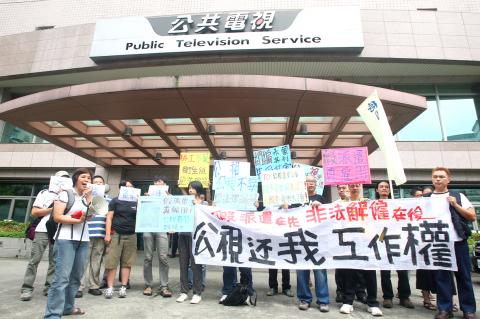
Photo: Hu Shun-hsiang, Taipei Times
However, instead of being notified that she has become a permanent employee, Chen received a letter last month telling her that she had been laid off.
“TBS has always said that it stands for the public interest and human rights. How can it treat its own employees like this then?” Chen asked.
The plight of dispatch workers has largely been overlooked until a series of protests by TBS temporary workers last year. The demonstrations revealed that the media group has been using about 20 dispatch workers to fill some of its 900 positions.
TBS defended the practice as a way to save on costs of salaries and employee welfare payments.
However, while dispatch workers are supposed to fill temporary jobs, all of TBS’ dispatch workers filled regular positions, with some having worked for the group for more than seven years.
Responding to the protests and public criticism, TBS management said that it would turn all dispatch workers into regular employees. However, six of them have been laid off since then.
Lee Chiung-yueh (李瓊月), a senior features reporter for Public Television Service (PTS), a member of the TBS group, also showed up to show her support for her former colleagues.
“We produced a lot of in-depth reports on labor disputes, and we criticized employers for using illegal practices in treating their employees, such as not giving them a chance to appeal when they are laid off,” Lee said. “How can we continue to criticize others if our own company does the same thing?”
“I am not the only one from the news department here; many of my colleagues are also here to lend their support,” she added.
National Federation of Independent Trade Unions executive director Chu Wei-li (朱維立) said TBS was dodging its responsibilities as an employer by using dispatch workers.
“These people work in the TBS building under the direction of TBS management, yet, you’re saying these people are employees of the employment agency and thus have nothing to do with you,” Chu said.
“It’s a shame for a media group that has a very ‘positive’ public image and claims that it cares a lot about human rights,” Chu said.

UPGRADE: The Kang Ding-class frigate is replacing its Chaparall missiles with Tien Chien II and Hua Yang VLS, which would provide it with long-range, 360° air defense Taiwan plans to produce 1,200 to 1,376 Hai Chien II missiles (海劍二, Sea Sword II) — also known as TC-2N — to serve as the standard air defense system of the navy’s surface combatant fleet, a source said yesterday. Last week, the Hai Chien II, the naval version of the Tien Kung II missile (天劍二, Sky Sword II), completed a live-fire test in waters off the National Chungshan Institute of Science and Technology’s Jiupeng facility (九鵬) in Pingtung County’s Manjhou Township (滿州). The MIM72 Chaparral and other dated air defense missiles that currently arm Taiwanese ships have inadequate range to combat Chinese

REASONS FOR TRAVEL: An assistant professor said that proposed amendments to penalize drivers if they used drugs overseas would not deter people from traveling People who operate a motor vehicle under the influence of marijuana would have their driver’s license revoked, even if they used the substance while overseas, the Ministry of Transportation and Communications said yesterday, citing proposed amendments to the Road Traffic Management and Penalty Act (道路交通管理處罰條例). The amendments would also authorize the government to revoke the licenses of people determined to have used Category 1 or Category 2 narcotics, even if they were not operating a vehicle while under the influence of drugs, as well as ban them from taking the license test for three years, the ministry said. People aged 18 or

HEAVY WEATHER: Typhoon Jangmi is due to crash straight into the Ryukyus as airlines look to shift flights to larger aircraft or cancel flights to Okinawa entirely Taiwan’s international air carriers announced flight adjustments over the weekend as Typhoon Jangmi is forecast to hit the Ryukyu Islands today and tomorrow. The Central Weather Administration (CWA) upgraded Jangmi from a tropical storm to a typhoon at 8am yesterday, with the eye located 580km south of Naha city. It was moving north at 19kph. Today, China Airlines’ CI-120, CI-121, CI-122 and CI-123 flights between Taoyuan and Naha, Okinawa, have been canceled as well as CI-132 and CI-133 between Kaohsiung and Naha. EVA Air’s BR-112, BR-113, BR-186 and BR-185 flights between Taoyuan and Naha are also canceled. Low-cost carrier Tigerair Taiwan canceled IT-230,
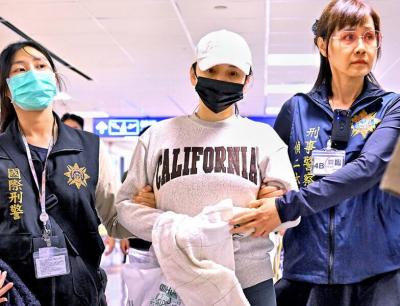
Johanne Liou (劉喬安), a Taiwanese woman who shot to unwanted fame during the Sunflower movement protests in 2014, returned to Taiwan last night after being deported from the US. She is to stand trial in Taiwan for charges involving embezzlement, fraud and drug crimes. The Criminal Investigation Bureau (CIB) said it took her into custody at Taiwan Taoyuan International Airport and would first question her before transferring her to the New Taipei District Prosecutors’ Office. She was arrested upon disembarking a flight from San Francisco that landed shortly before 7pm. Liou absconded to the US in 2019 after jumping bail


 RSS
RSS